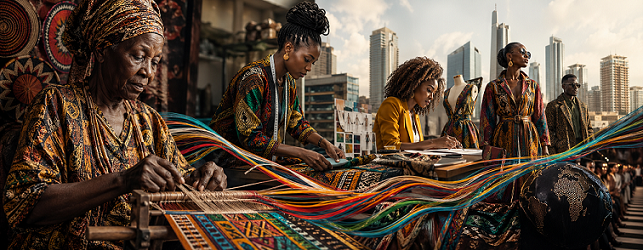
There is a woman in Nairobi's Gikomba market who can tell the origin of a fabric by feeling its weight. Not just the country — the region, the decade, the family tradition. She has been doing this for forty years. Her mother did it before her. Her grandmother before that. The knowledge lives in her fingertips, passed down without a textbook, without a classroom, without a certificate.
There is a woman in rural Alabama who quilts every Sunday afternoon. She learned from her grandmother, who learned from her grandmother, who was enslaved. The pattern she sews — a complex geometric called Bear's Paw — is one she cannot fully explain. She only knows it is the one her people always made, and that making it feels like praying.
These two women have never met. They speak different languages. They live on different continents, separated by an ocean and four centuries of deliberate disconnection. And yet the knowledge in their hands comes from the same place.
What Was Carried and How
When historians account for what enslaved Africans brought to the Americas, they tend to focus on what was taken — language, religion, family, name, homeland. Less discussed is what was preserved. Not in documents or artifacts that could be confiscated and destroyed. In bodies. In muscle memory. In the precise, repeated motion of hands that knew how to spin, weave, dye, and stitch.
West and Central Africa had among the most sophisticated textile traditions on earth before European contact. The Kente cloth of the Akan people, woven on horizontal strip looms in Ghana, was not merely decorative — it was a language. Each pattern carried specific meaning: social rank, clan identity, occasion, aspiration. A chief's cloth communicated his lineage the way a flag communicates nationhood. The weaver who made it held specialized knowledge accumulated over generations, transmitted through apprenticeship.
The Kuba people of what is now the Democratic Republic of Congo produced interlace geometric patterns of such mathematical complexity that contemporary textile scholars are still analyzing their structure. The Yoruba of southwestern Nigeria developed indigo resist-dyeing — a method of creating patterns in cloth by preventing dye from reaching specific areas — that was technically equivalent to processes being developed simultaneously in Japan, with no contact between the traditions. The knowledge was arrived at independently, in parallel, because human beings who observe plants and experiment with color will, given enough generations, discover the same things.
All of this knowledge was in the bodies of the people who were enslaved. And bodies cannot be stripped of what they know.
"The enslaved brought their whole selves. That included what their hands could do. And what their hands knew about cloth was civilization."
The Plantation as Preservation Site
This is a deeply uncomfortable truth about American slavery: the plantation was, in certain terrible ways, a site of African cultural preservation. Not because enslavers wanted to preserve African culture — they worked hard to destroy it. But because the skills they needed to profit from enslaved labor were precisely the skills the enslaved brought from Africa.
Rice cultivation in South Carolina and Georgia was almost entirely dependent on West African knowledge. The enslaved people brought from Senegambia and Sierra Leone — regions with deep rice-farming traditions — were specifically sought because of what they knew. Planters who had no idea how to grow rice relied completely on the expertise of the people they claimed to own. The knowledge kept the crop alive.
The same was true of indigo. The indigo-processing techniques used on South Carolina plantations in the 18th century — among the most profitable agricultural operations in colonial America — were West African in origin. Enslaved dyers who knew how to ferment and fix indigo in the precise way necessary to produce a stable dye were irreplaceable. Their knowledge was so valuable that some enslaved women who were expert dyers were never sold, regardless of economic pressure, because their loss would have been too costly.
Colonial-era plantation ledgers from the Carolinas document "indigo women" as a distinct and highly valued category of enslaved labor. In some records, their names appear where most enslaved people's names do not — because their skills had made them individually irreplaceable. Their knowledge was African. The profits their knowledge generated built American fortunes.
The Quilt as Archive
After emancipation, without the plantation as an organizing structure, African American textile knowledge had to find new containers. It found them in quilts.
The African American quilting tradition — now recognized as one of the great art forms of the United States — looks different from European quilting in ways that matter. European quilting tends toward regular, symmetrical patchwork: the nine-patch, the log cabin, the double wedding ring. African American quilts, particularly those made in the South through the 19th and into the 20th century, tend toward asymmetry, improvisation, bold color contrast, and strip construction — the use of long strips of fabric sewn together, which is structurally identical to the strip-weaving techniques of West African kente.
This is not coincidence. The connections are formal, structural, mathematical. Scholars of African American art history — including Maude Southwell Wahlman, Robert Farris Thompson, and John Vlach — have documented these connections extensively. The patterns differ. The structural logic is the same. It crossed the Atlantic in the bodies of people who never got to go back.
The quilts served practical functions: warmth, material use. But they served cultural functions that may have been more important. They were the one place where African aesthetic values — asymmetry, improvisation, bold contrast, the integration of found materials — could survive and be expressed without punishment. A quilt could not be accused of African cultural subversion. It was just a blanket.
"Every time I make a quilt, I feel like I'm talking to someone I never got to meet. I don't know her name. But she taught me this."
Gee's Bend: Where the Evidence Is Undeniable
The quilts of Gee's Bend, Alabama — a small, isolated community of African Americans descended from the enslaved people of a single plantation — have become, in the past three decades, arguably the most studied body of textile work in American history. The Whitney Museum of American Art mounted a major exhibition of Gee's Bend quilts in 2002, and the catalog drew comparisons not to American folk art, but to abstract expressionism, Mondrian, Klee.
What the art world called "abstract" and "modern," the women of Gee's Bend called the way they had always done it. Their mothers had done it this way. Their grandmothers. The boldness, the improvisation, the structural departure from European quilting norms — none of it was innovation. It was inheritance.
What strikes scholars who study both West African textiles and Gee's Bend quilts is the presence of specific aesthetic principles that appear in both traditions: the use of strong diagonal movement, the repetition of a core motif with deliberate variation, the integration of "mistakes" as part of the design rather than flaws to be hidden, and the treatment of the quilt surface as a field of improvisation rather than a plan to be executed.
These are not accidental similarities. They are the same aesthetic, expressed in different materials, separated by centuries and an ocean.
The Fashion Industry and the Question of Credit
In the 21st century, the global fashion industry has rediscovered what it calls "African-inspired" design. Kente cloth appears on runways from Milan to New York. Ankara prints are adopted by fast fashion labels that sell them to consumers who may have no idea of their origin. Geometric patterns with deep roots in Kuba textile tradition appear on luxury accessories with no attribution to the culture that developed them.
This is the latest iteration of a very old story — the story of African aesthetic knowledge generating value for people who did not create it and do not credit it.
Bleu Allusion Group was founded on a different premise: that the value of African creative knowledge should flow back to the people who hold it. That the Kenyan maker, the Ghanaian weaver, the Nigerian print designer should be named, paid, and celebrated — not anonymously sourced, not appropriated, not stripped of credit the way the indigo women were stripped of credit for the fortunes they generated.
The thread never broke. It runs from the indigo fields of Senegambia to the plantation dye houses of South Carolina to the quilting circles of Alabama to the studios of Nairobi and the runways of Atlanta. What Bleu Allusion is trying to do — what SEMA is trying to make visible — is trace that thread. Not as an academic exercise. As an act of restoration.
The Knowledge Is Still Here
The woman in Gikomba market who can identify a fabric by its weight is not a relic. She is a library. The woman in Alabama who quilts every Sunday is not performing nostalgia. She is practicing a discipline that her people developed under conditions of extreme oppression and maintained for generations through deliberate transmission.
Between them — across the ocean, across the centuries, across the language gap — is a continuous tradition of knowing that cloth is not just cloth. That what your hands know how to make carries who you are, where you come from, and what survived. That the knowledge in the body outlasts everything they try to take.
We are, all of us who participate in this tradition, the inheritors of something that was not supposed to survive. The thread never broke. And it does not need us to repair it. It only needs us to recognize it — and to follow it home.